A Fielder’s Choice
The still morning air of this late August carried a warning. It should have been noticed. The signal was missed. Like every morning that joined this summer of dryness, a thin blanket of fog settled onto the ball field, covered the foliage and teased the plants with a thin layer of dew. The spring flowers had long since dried and faded from their early color—the May blankets of dandelions had sent infinite numbers of spores to the wind, the yellow bellworts were a wrinkled brown, the light purple of the lilacs long faded. The cycle of petals and bloom—the daisies, black-eyed Susan’s, purple thistles, goldenrod and now the bursting milkweed pods—had each taken a turn on the ball field. Like every other daybreak this summer, the darkness of the night was gently rousted with the soft notes of a few sparrows in back of third base and like every other morning, the sun quietly slid above the spindly jack pines that were crowding toward right field, light seeped into the eastern sky and chased the darkness from this season with no rain.
Comment Baseball was a huge part of the Fenske family from the early 1020’s until I graduated from college. Dad played until he was nearly 50 years old and he was subsequently the manager, grounds keeper, and cheerleader for my baseball career. Our family seldom fished; we instead hurried to ball practice twice a week after the evening milking for catch, hitting, and infield practice. Either Saturday night or Sunday morning, we would drag the ball, set the bases, and poor lime to mark the baselines. We would mow the outfield grass and, Sunday morning, load ice and pop into a big stock tank in the back of our pickup. Mom would sell the pop on those hot summer days while the men played the game. Kids were expected to shag balls until they were old enough for a uniform. My assignment was always behind first base, an area that often intruded into the sumac and poison ivy of Moen’s pasture. Dad would ensure that we had enough good bats and balls, hire an umpire, and arrange for rides for our games away. He had to make the decision to cancel a game if there was a threatening storm approaching. A special event happened when Carr Lake families gathered at the school for a caravan to Minneapolis to watch a Twins game.
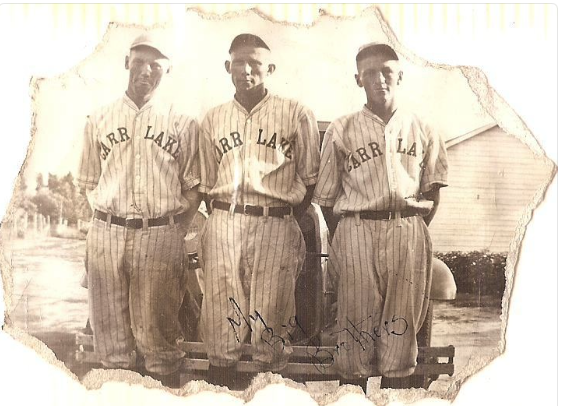
Wednesday evenings were always set aside for ball practice. This middle of the week gathering had been special for over two decades in Carr Lake. Sundays, game days, were more serious. Veteran players said about the past, “Those were the days when a guy slid with his spikes up!” Wednesdays were the time to learn and have fun. Cows were hurried into their evening pastures after early milking, timber haulers returned from the local mill with empty trucks late in the afternoon. Mill workers traded shifts. A Carr Lake farmer would never chance cutting a field of hay if there was any chance that it would turn dry enough for stacking during those special hours before Wednesday dusk. Ball practice was a melting pot. It was fun. It was democratic! Men of all ages loosened their arms, swung bats, and chased fly balls. It was here that young boys first heard the good stuff about girls, where other gossip was exchanged only in whispers, and where a player could be razzed about his particular skills or lack thereof.
 The Whitefish Journal